

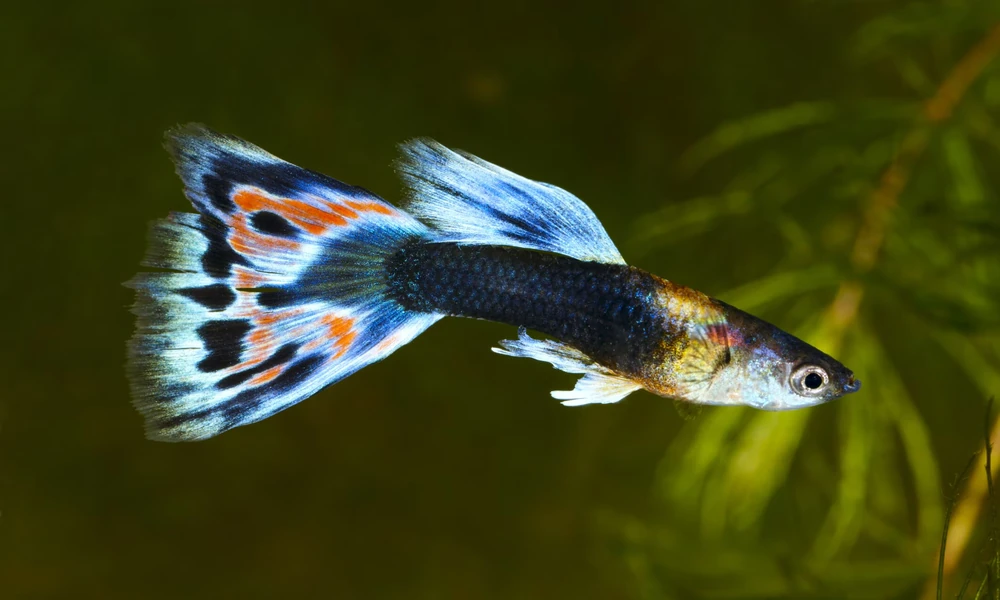
Few species are recommended to beginners as often as the guppies, and for good reason: they combine vivid colour, easy breeding, and forgiving water requirements in a way few other tropical fish manage. This care sheet covers the essentials, from tank setup to common health issues.
Tank and Water Requirements
A minimum tank size of 40 litres suits a small group comfortably, with a stable heater set between 22 and 28 degrees Celsius and gentle filtration. A pH between 7.0 and 8.0 and moderately hard water suits most captive-bred lines well, and weekly partial water changes of around 25 percent keep ammonia and nitrite at safe levels.
Diet
Guppies are omnivorous and thrive on a varied diet of high-quality flake or micro-pellet food, supplemented occasionally with live or frozen brine shrimp or daphnia. Small, frequent feedings suit their small stomachs better than one large daily feed, and uneaten food should be removed promptly to protect water quality.
Breeding Behaviour
As livebearers, female guppies give birth to free-swimming fry roughly every four to six weeks once mature, often without any deliberate breeding effort on the keeper’s part. A heavily planted tank or dedicated breeding trap helps fry survive their first few days, since adult guppies, including their own parents, will readily eat newborn fry if given the chance.
Temperament and Compatibility
Guppies are peaceful, active, and generally sociable, doing well in community tanks alongside corydoras catfish, small tetras, and other livebearers. Avoid housing them with known fin-nippers, since their flowing tails are an easy target, and keep a reasonable ratio of females to males to reduce excessive mating stress on individual females.
Health Watch-Outs
Fin rot, ich, and swim bladder issues linked to overfeeding are the most commonly reported problems, nearly all of which are preventable with stable water quality and a sensible feeding routine. Watch for clamped fins, listlessness, or a loss of appetite as early warning signs worth investigating promptly.
When choosing stock, guppy fish from a specialist retailer with dedicated quarantine practices tends to arrive in noticeably better condition than fish from a generic pet aisle carrying dozens of unrelated species.
Colour and Fin Variety
Selective breeding has produced dozens of recognised strains, from cobra and mosaic patterns to tuxedo and grass varieties, each with distinct fin shapes such as delta, veiltail, or fantail. Males display the most dramatic colour and fin development, while females remain comparatively plain but noticeably larger.
Quick Reference Summary
Tank size: 40 litres minimum. Temperature: 22-28°C. pH: 7.0-8.0. Diet: flake or micro-pellet plus occasional live or frozen food. Breeding: continuous once mature, roughly every four to six weeks. Typical lifespan: two to three years with consistent care.
Water Chemistry in More Detail
Beyond the headline temperature range, pH and hardness matter more than many new keepers realise for guppies. A pH between 7.0 and 8.0 suits most captive-bred stock, since the species naturally favours slightly harder, more mineral-rich water than many other popular tropical fish. Most UK tap water, once treated with a dechlorinator, sits comfortably within an acceptable range without further adjustment.
Cycling a new tank properly before adding fish remains the single most important preparatory step. A tank that hasn’t developed a stable colony of beneficial bacteria will see ammonia and nitrite spike quickly once livestock is introduced, and even a generally hardy species can suffer noticeably under those conditions.
Substrate, Décor, and Enrichment
Fine sand or smooth gravel works well for guppies, and dense planting, particularly floating varieties, gives fry and lower-ranking fish somewhere to retreat. Sharp-edged décor is best avoided, since it can damage delicate fins during normal exploration of the tank.
A consistent light cycle of around eight to ten hours daily helps establish a predictable routine and supports any live plants without encouraging excessive algae growth. Fish kept on an irregular or overly long light cycle can show subtly increased stress over time compared with those on a stable schedule.
Handling and Acclimatisation
Time spent in transport should be kept as short as possible for guppies, since small volumes of water change temperature and oxygen levels quickly. Float the sealed bag in the destination tank for around fifteen minutes, then gradually mix in tank water over a further period before release.
Personality varies noticeably between individuals, even within the same colour strain, and this is worth bearing in mind when assessing whether a fish is settling in normally. Bold, inquisitive behaviour from day one is a good sign but not the only good sign; a more cautious fish that gradually becomes more confident over the first couple of weeks is equally normal.
Sourcing Live Plants Safely
Live plants offer real benefits alongside guppies, including natural cover and subtle water quality improvements, but they should be rinsed thoroughly or quarantined before introduction, since plants from mixed retail displays can occasionally carry pest snails or pesticide residue.
A properly cycled tank will show consistently low or zero ammonia and nitrite readings alongside a measurable, gradually rising nitrate level, which indicates the beneficial bacteria colony is established and functioning correctly. Testing at this stage, before introducing fish, gives far more useful information than testing reactively after a problem has already appeared.
Signs of a Well-Adjusted Fish
A settled, healthy group of guppies typically shows steady appetite, active exploration of the tank, and a willingness to approach the glass when their keeper is nearby. These behavioural signs are just as useful an indicator of overall wellbeing as physical appearance.
Seasonal Temperature Management
UK homes can experience noticeable temperature drops during colder months, particularly overnight, so it’s worth checking that a heater is appropriately sized for the tank volume rather than simply the smallest or cheapest option available. A thermometer placed away from the heater itself gives the most accurate read of the water the fish actually experience.
A final practical note: keep spare filter media and a backup thermometer on hand where possible for guppies, since replacing a failed component quickly matters more than for hardier species less sensitive to sudden changes in water quality or temperature. A small spares kit costs very little relative to the setup as a whole and removes one more source of potential stress for the fish.
Finally, it’s worth checking in on guppies at different times of day rather than only at feeding time, since activity levels and behaviour can shift noticeably between morning and evening. A fish that seems quiet in the morning but active and engaged later in the day is very likely just settling into a natural daily rhythm rather than showing any sign of a problem.
Choosing Compatible Plants
Beyond guppy grass, java fern, anubias, and floating plants such as amazon frogbit all suit guppies well, offering cover and mild water quality benefits without demanding much in the way of specialist lighting or fertilisation. A mix of floating and rooted plants tends to give the most natural, varied environment.
Regular observation over the first month of ownership helps establish what normal behaviour looks like for a specific group, making it considerably easier to notice a genuine change later. Small variations in activity level from day to day are entirely normal and rarely indicate a problem on their own.
Building a Simple Maintenance Routine
A short weekly routine covering water changes, a visual health check, and a glance at equipment for guppies takes only a few minutes but prevents the overwhelming majority of problems that catch new keepers off guard. Consistency matters far more than any single piece of specialist equipment.
Keeping a simple record of feeding, water changes, and any observations, even briefly, makes it considerably easier to spot a gradual pattern over time, whether that’s a slow decline worth investigating or confirmation that the current routine is working well.
Long-Term Observation Habits
Checking on guppies at more than one point in the day, rather than only at feeding time, gives a more complete picture of normal behaviour and makes genuine changes easier to notice. Activity levels naturally shift throughout the day, and a fish that seems quiet in the morning but engaged in the evening is very likely just following a normal rhythm.
Over months and years, small adjustments to routine, whether a slightly different feeding schedule or a change in lighting duration, often reveal themselves through subtle shifts in colour or activity, which is part of why experienced keepers tend to make changes gradually and observe the results before making further adjustments.
Adjusting Care as a Tank Matures
The needs of guppies shift subtly as a tank matures, with a newly established setup generally requiring closer monitoring than one that’s been stable for six months or more. Feeding amounts, water change frequency, and even lighting duration are all worth revisiting periodically rather than treated as fixed decisions made once at the outset.
Keeping half an eye on how the tank changes over time, rather than only reacting when something goes visibly wrong, tends to produce noticeably better long-term outcomes and a more confident, experienced keeper over the following months.
The Value of Patience in Long-Term Care
Much of what makes guppies thrive over the long term comes down to patience rather than any single dramatic intervention. Resisting the urge to overhaul a tank in response to a minor issue, and instead making small, considered adjustments while observing the results, tends to produce far more stable outcomes.
Keepers who approach the hobby with this mindset, treating each tank as an evolving, living system rather than a fixed display to be perfected immediately, generally report far greater long-term satisfaction and considerably fewer avoidable losses along the way.
As a final note, it’s worth remembering that no care sheet can fully replace the judgement a keeper builds through direct experience with their own guppies. Use guidance like this as a solid starting framework, but trust what you observe in your own tank over time, since every setup develops its own particular rhythm.
In short, consistent basics beat occasional heroics when it comes to keeping guppies healthy over the long term, and that principle holds true regardless of how much the wider hobby continues to evolve.
With a properly set up tank and a little attention to water quality, guppies remain one of the most forgiving and rewarding species for UK fishkeepers, whether the goal is a simple colourful community tank or a more deliberate breeding project.