

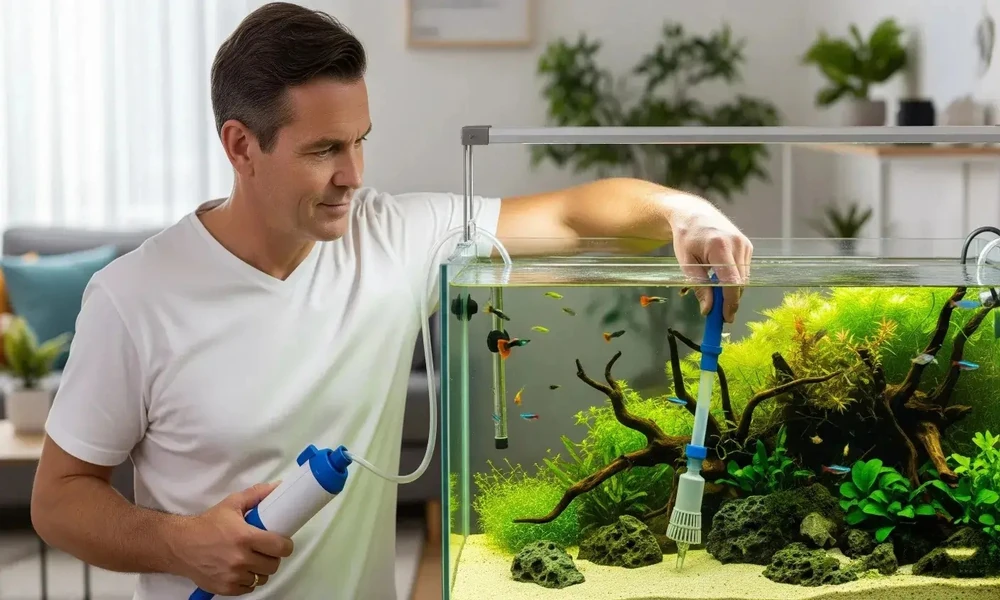
If your tank water has gone from crystal clear to cloudy green in a matter of days, the fix usually isn’t more chemicals; it’s having the right fish tank cleaning supplies on hand and a routine you actually stick to. Cleaning a tank properly protects your fish from ammonia spikes and algae blooms, and it doesn’t take more than 20 to 30 minutes a week once you’ve got a system down.
What Fish Tank Cleaning Supplies Do You Actually Need?
You don’t need a garage full of gear. You just need a handful of tools used consistently. Here’s what belongs in every aquarium owner’s cleaning kit:
| Supply | What It’s For |
| Gravel vacuum / siphon | Removes waste and debris from the substrate during water changes. |
| Algae scraper or pad | Clears algae film from glass or acrylic walls. |
| Bucket (fish-only, never used for soap) | Holds water for changes and rinsing. |
| Water conditioner | Neutralizes chlorine and chloramine in tap water. |
| Soft sponge or cloth | Wipes down the tank exterior and lid. |
| Filter media (as needed) | Replaces or rinses clogged filter cartridges. |
Good aquarium cleaning supplies don’t need to be expensive – a basic siphon and scraper handle 90% of routine maintenance. Where people run into trouble is skipping the water conditioner or scrubbing with anything that’s touched dish soap, which can leave behind residue that’s toxic to fish.
Step-by-Step Guide to Cleaning a Fish Tank
Once your fish tank cleaning supplies are laid out, the actual cleaning process is pretty mechanical. Here’s the order that works best:
- Unplug electrical equipment – Heaters and filters should be off before you put your hands in the water.
- Scrape the glass – Algae comes off easier before you disturb the water with a siphon.
- Vacuum the substrate – Work in sections, lifting debris without removing too much beneficial bacteria.
- Change 10-20% of the water – More than that in one go can shock fish with sudden parameter shifts.
- Refill with conditioned water – Match the temperature closely to avoid stressing your fish.
- Rinse filter media in old tank water – Never use tap water, which kills the beneficial bacteria living in it.
- Wipe the exterior and lid – A quick pass with a damp cloth keeps grime from building up outside the tank.
Skipping step 6 is probably the most common mistake. Rinsing filter sponges under the tap wipes out the bacteria colony that’s actually keeping your water safe, which then shows up a few days later as a cloudy, ammonia-smelling tank.
How Often Should You Clean a Fish Tank?
Frequency depends more on your bioload than your tank size. A heavily stocked 20-gallon needs more attention than a lightly stocked 55-gallon.
| Task | Frequency |
| Partial water change (10-20%) | Every 1-2 weeks |
| Glass/algae scraping | Weekly, or as needed |
| Gravel vacuuming | Every water change |
| Filter media rinse | Every 4-6 weeks |
| Full filter replacement | Every 2-3 months |
| Deep clean (decor, glass edges) | Monthly |
Choosing the Right Fish Tank Cleaner
Not every fish tank cleaner on the shelf is safe for every setup, so it’s worth matching the product to your specific problem instead of grabbing whatever’s cheapest:
- Algae specifically: A magnetic algae scraper is gentler on acrylic tanks than a bladed one.
- Cloudy water: A liquid clarifier can help, but it’s a band-aid. The real fix is usually a bigger or more frequent water change.
- Hard water stains: A vinegar-and-water solution on empty tanks works better than most commercial cleaners, and it’s fish-safe once rinsed thoroughly.
- Filter grime: A soft filter brush, not a scraper, prevents damage to delicate media.
When comparing aquarium cleaning supplies, skip anything labeled for household glass or countertops. Even trace amounts of ammonia-based cleaners are enough to harm fish.
Final Thoughts
A clean tank isn’t about scrubbing until it sparkles; it’s about steady, small maintenance that keeps water chemistry stable for your fish. Stock the basics, stick to a weekly-ish rhythm, and you’ll spend far less time fighting cloudy water or algae outbreaks down the line.
FAQs
Q. What supplies do you need to clean a fish tank?
At minimum: a gravel vacuum, algae scraper, a dedicated bucket, water conditioner, and a soft cloth. These core fish tank cleaning supplies cover water changes, glass cleaning, and general upkeep.
Q. What is the best cleaning solution for a fish tank?
For the water itself, a dechlorinating conditioner added at every water change is essential. For scrubbing surfaces, plain water or a diluted vinegar rinse on empty tanks works better than most commercial cleaners.
Q. What is the best thing to use to clean an aquarium?
A magnetic or handheld algae scraper paired with a gravel vacuum handles most routine cleaning. Avoid household glass cleaners entirely, since residue can be toxic to fish.
Q. How do I keep my fish tank crystal clear?
Stick to regular partial water changes, avoid overfeeding, and don’t overclean the filter. Beneficial bacteria in the filter media are what actually keep water clear and stable between cleanings.
Q. What equipment do I need to clean my fish tank?
A siphon/gravel vacuum, algae pad, fish-only bucket, and water conditioner form the essential toolkit. Anything beyond that, such as clarifiers and specialty brushes, is optional depending on your tank’s specific issues.