

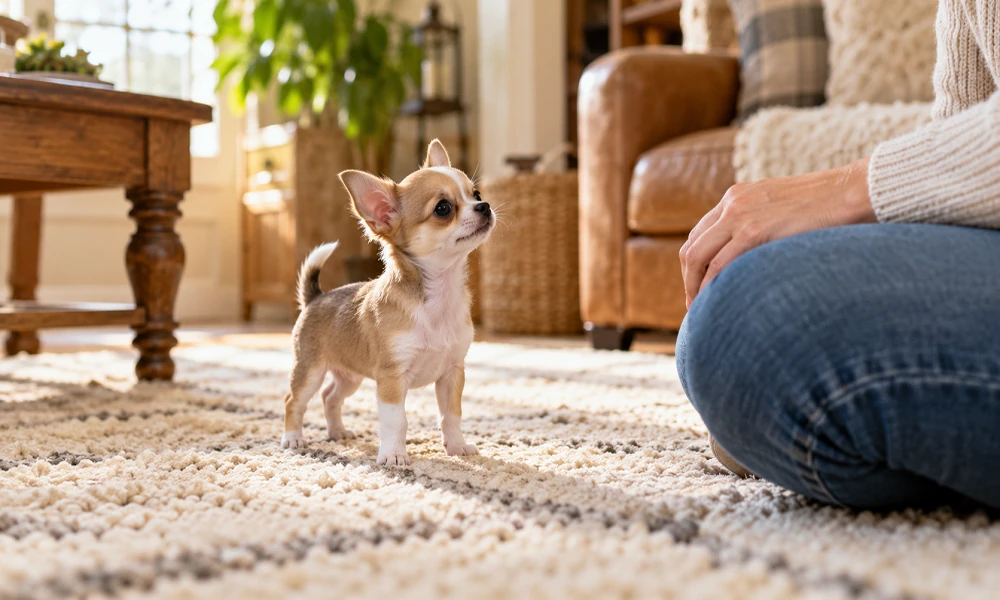
I have been raising Chihuahuas on my 12-acre property in rural West Tennessee since 2005. In that time, I have watched hundreds of families welcome one of my puppies into their home – and I have seen firsthand what sets a smooth transition apart from a rocky one. It almost always comes down to two things: a patient potty training routine and thoughtful early socialization. If you are somewhere in the process of finding a reputable Chihuahua breeder in Tennessee and preparing for a new Chihuahua puppy, this guide is written with you in mind.
Chihuahuas are not small dogs in a big-dog world. They are a breed entirely unto themselves – fiercely loyal, deeply bonded to their families, and surprisingly sensitive to their environment. That sensitivity is part of what makes them so endearing, but it also means they need a little more patience and intentionality than many new owners expect. The good news is that with the right foundation, these tiny dogs become wonderfully confident, well-adjusted companions.
Start by Learning What Your Breeder Has Already Done
Before your puppy ever sets foot in your home, I encourage you to have a real conversation with your breeder about how that puppy has been raised. At Dreamer’s Pups, I raise every litter inside our family home alongside children, which means our puppies are already accustomed to household sounds, gentle handling, and the unpredictable energy of kids. That early exposure makes a genuine difference.
Ask your breeder specific questions: Where does the puppy sleep? Has it been handled daily? Does it have experience with children, other dogs, or different flooring textures? The answers tell you a lot about what your puppy already knows and what you will be building on. A puppy that has been touched, spoken to, and engaged with from its earliest weeks will adapt to your household far more quickly than one that has not had that attention. The start your breeder gives a puppy is not just a selling point – it is the foundation your training will stand on.
Building a Potty Routine That Actually Works
Chihuahuas are smart, but their small bladder means they genuinely cannot wait as long as a larger breed can. For a young puppy, I recommend taking them outside at these key moments: first thing in the morning, immediately after every meal, right after a nap, and after any play session. During the day, plan for an outdoor trip every one to two hours. At night, especially in the early weeks, you may need to set an alarm for a middle-of-the-night break.
Consistency in location matters more than most people realize. Pick one specific spot in your yard and bring your puppy there every single time. The familiar scent cues them to go. When they do go, praise them warmly and follow up immediately with a small treat. Do not wait even thirty seconds – the reward needs to connect directly to the behavior. Chihuahuas are people-pleasers at heart, and that verbal praise from you means a great deal to them.
One practical tip I share with every new Dreamer’s Pups family: keep a log for the first two weeks. Note the times your puppy went outside successfully and the times an accident happened indoors. Patterns emerge quickly, and that information helps you get ahead of your puppy’s needs instead of reacting after the fact. Readers who want additional structure can explore puppy potty training tips as a supplementary reference.
Handling Accidents Without Losing Your Patience
Accidents are part of the process, full stop. When one happens, the worst thing you can do is scold, startle, or make a scene about it – especially with a Chihuahua. This breed is remarkably sensitive to a raised voice or tense energy. A puppy that gets frightened after having an accident does not learn where to go next time; it learns to hide from you when it needs to go, which makes the whole process harder.
When you find an accident, clean it up with an enzyme-based cleaner to fully eliminate the scent, and then look honestly at your schedule. Did you stretch too long between outdoor trips? Was the puppy playing excitedly and you missed the signal? Common signs that a Chihuahua needs to go include circling, sniffing at the floor, and suddenly pausing mid-play. The moment you see any of those, head outside.
Cold or rainy Tennessee weather can also be a real obstacle with Chihuahuas. They genuinely feel the cold more than larger breeds do, and a shivering puppy standing on wet grass is not going to focus on potty training. A small dog sweater and a dry, sheltered spot in your yard can make outdoor trips feel less like a battle of wills. If accidents seem to increase with weather changes, that is almost certainly why.
Socializing Your Chihuahua: Small Steps, Lasting Confidence
Socialization and potty training happen in parallel during those first weeks at home, and it is worth giving socialization just as much thought. Chihuahuas have a known tendency toward fear reactivity when they are not exposed to varied experiences early and gently. A puppy that only ever sees the same two people in the same quiet house can develop anxiety around anything unfamiliar – and that anxiety often shows up as trembling, barking, or snapping later on.
The key word in all of this is gradual. Introduce one new thing at a time: a new person, a new sound, a new surface underfoot like tile or hardwood if your home has carpet. Keep each introduction brief – a few minutes is enough. Pair every new experience with something your puppy loves, whether that is a treat, a favorite toy, or calm praise from you. End the interaction before your puppy becomes overwhelmed, which means reading body language continuously.
When a visitor comes to meet your puppy, ask them to sit at floor level and simply let the puppy approach in its own time. Chihuahuas that are pressured into contact – someone leaning over them, reaching down, or trying to force a cuddle – often become more fearful, not less. A guest who sits quietly and lets the puppy investigate on its own terms will almost always get a much warmer response. The AVMA puppy socialization guidelines is a helpful reference if you want to read more broadly on this topic.
Your puppy should always have access to a safe retreat – a crate, a dog bed, a corner of the couch – where no one follows it. That sense of having a place to decompress is important for small dogs that can easily feel overwhelmed by household activity.
Chihuahuas and Children: A Few Ground Rules
One of the questions I hear most often is how to manage the relationship between a new Chihuahua puppy and young children. My puppies grow up around kids here at Dreamer’s Pups, so they come to you with a real head start. But that early exposure does not replace adult supervision, especially at first.
Teach children to sit on the floor before holding or petting the puppy, rather than picking it up while standing. A Chihuahua dropped even a short distance can suffer a serious injury – their small bones are fragile, and their fontanel (the soft spot on the top of the skull, present in many Chihuahuas) requires particular care. Encourage slow, gentle petting rather than patting or grabbing, and make sure children understand that the puppy needs quiet rest time, too.
Chasing, cornering, and playing too roughly are all behaviors to redirect immediately – not because the Chihuahua cannot handle it short-term, but because repeated rough handling chips away at a puppy’s trust and can create lasting anxiety around children.
What Confident Socialization Actually Looks Like
Many owners measure socialization success by counting how many new people or dogs their puppy has met. In my experience, the more useful measure is how your puppy moves through new experiences. A well-socialized Chihuahua will approach new things with curiosity rather than panic. It will recover quickly after a surprise – a loud noise, an unfamiliar dog passing on a leash – rather than staying anxious for a long stretch afterward.
Watch for a soft, loose body posture, a gently wagging tail, and willingness to take a treat even in a mildly new situation. These are signs that your puppy feels secure. A stiff body, tucked tail, flattened ears, or refusal to eat in a setting that was previously comfortable are all signals to slow down and make things easier, not to push through.
Brief, positive handling practice is also worth building into your daily routine. Pick up your puppy, touch its paws, look in its ears, and then put it down and reward it. Veterinary visits, grooming appointments, and nail trims go infinitely better when a dog has been conditioned to accept gentle handling from puppyhood.
Continuing the Work at Home
Every Chihuahua I place with a family comes with a foundation built in that first six to eight weeks – cleanliness, daily handling, exposure to children, and the early seeds of trust. The families who see the best outcomes are the ones who carry that work forward with consistency, patience, and a genuine willingness to meet their puppy where it is. Not every puppy learns at the same pace, and that is perfectly okay.
If you are ready to take the next step, I would love to talk with you about our available puppies and answer your questions about what life with a Chihuahua from Dreamer’s Pups really looks like. Visit Dreamer’s Pups to learn more about our family-raised puppies and what to look for when choosing a Chihuahua breeder in Tennessee.