

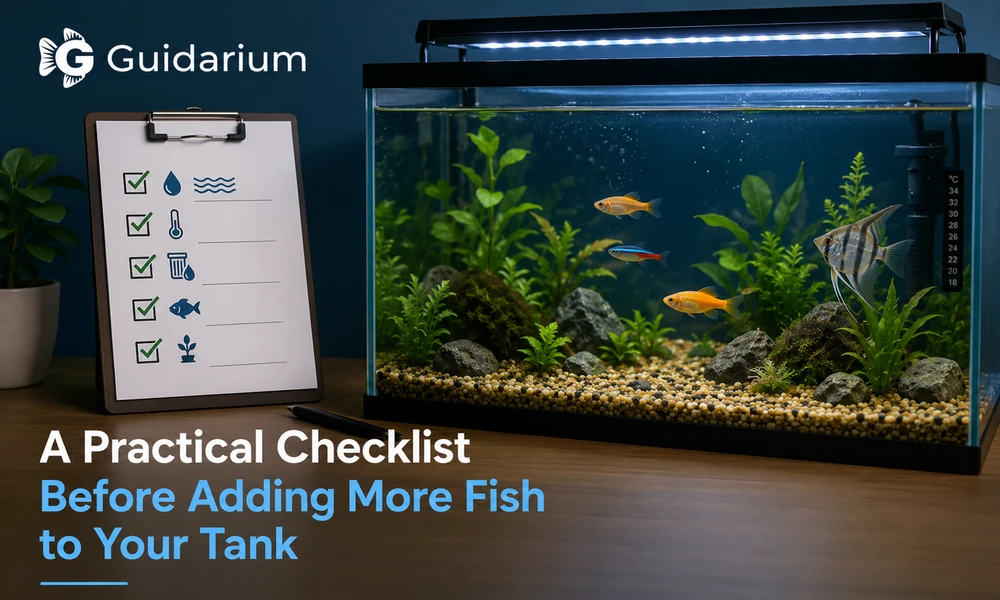
Adding another pet to an existing setup usually sounds easier than starting from scratch. That is true whether someone is thinking about another guinea pig, another backyard chicken, or another fish. With aquariums, though, the limits are easier to miss because so much of the pressure is invisible. Water quality can look fine right up until it is not. Social tension can build long before obvious fighting starts. A tank can seem roomy to the owner while feeling crowded to the animals living in it.
That is why adding fish to an established aquarium often feels simpler than it really is. The tank is already running. The filter is established. The water looks clear. The fish that are in there seem settled. So when you see a few open-looking gaps in the middle of the tank or a species at the store that appears “small enough,” it is easy to assume you have room.
That assumption is where many stocking mistakes begin.
The risky part is not usually the single fish you are thinking about today. It is the combined effect of one more group, one more territorial species, one more waste source, or one more demand on a routine that is already close to its limit. A tank can look calm and still be carrying more biological, spatial, and behavioral pressure than it appears to on the surface.
Before you add anything, step back and treat the decision like a checklist rather than an impulse. The goal is not to make stocking feel complicated. The goal is to catch the obvious failure points before they become algae spikes, aggression problems, repeated losses, or a tank that always feels slightly unstable.
Below is a practical sequence to use before bringing home more fish.
Start with the real water volume, not the label on the tank
Many stocking decisions go wrong because the fishkeeper is working from the tank’s marketed size rather than the amount of water the system actually holds. Those are not always the same thing.
Manufacturers usually advertise a nominal volume. In practice, usable water volume is affected by:
- the true interior dimensions
- substrate depth
- decor such as rocks and wood taking up space
- water level below the rim
- internal equipment taking up space
A tank sold as a certain size may hold meaningfully less water once it is filled, decorated, and running normally. That matters because every later decision, from filtration expectations to how heavily the tank can be stocked, is built on that baseline.
If you have never calculated the tank from its dimensions, do that first. Guidarium’s cuboid aquarium volume calculator is useful here because it gives you a cleaner starting point than guessing from the box label. Even if the result confirms what you thought, you have replaced assumption with something measurable.
This is especially important for smaller tanks. Being off by a modest amount in a large aquarium may not change much. Being off by the same amount in a small tank can significantly change how much margin you really have.
Look at the fish you already own as adults, not as they appear today
Many tanks feel understocked only because the current residents are juveniles, subadults, or recently introduced fish that have not filled out yet.
Before adding anything, list the fish already in the aquarium and ask four simple questions:
How large will each species get in this setup?
Do not use current body size as your guide. Use realistic adult size in captivity, and think about body mass, not just length. A deep-bodied fish and a slim schooling fish of the same length do not place the same demands on space or filtration.
Are they already under-grouped?
Some aquariums look like they have room for more fish, but the real correction is not a new species. It is bringing an existing shoaling or schooling species up to a proper group size. In simple terms, these are fish that feel safer and behave more normally when kept with their own kind. A tank with too few tetras, rasboras, or corydoras may look sparse, yet the better move is often to complete the group rather than add something different.
Are any current fish likely to become more assertive with age?
Juveniles are often tolerated more easily than adults. Territorial cichlids, semi-aggressive barbs, larger gouramis, some loaches, and even certain community staples can shift behavior as they mature. A tank that is peaceful now may already be close to its future social limit.
Are breeding behaviors likely to change the balance?
Pair formation, spawning territory, guarding fry, and male competition can all alter how much effective space is available. The tank you have today may not behave like the same tank a few months from now.
If your current stock is still growing, your available capacity may be smaller than it looks.
Decide whether the empty-looking space is actually usable space
Many people read visual emptiness as stocking capacity. But open water does not automatically mean functional room for more fish.
Ask what kind of space is actually available:
- bottom footprint
- midwater swimming lanes
- upper-level resting areas
- shaded refuge
- line-of-sight breaks
- territory boundaries
A tank can have open glass in the front and still be “full” in every way that matters. Bottom dwellers may already be competing over the same caves. Midwater fish may already be crossing each other’s paths constantly. Surface fish may already be using the calmest strip under the filter return.
This is why stocking by looks alone fails so often. What matters is not whether the tank appears busy to you from across the room. What matters is whether the fish can occupy their preferred zone without chronic competition.
Check whether your reason for adding fish is actually a stocking reason
Not every urge to add fish points to a genuine stocking opportunity. Sometimes it points to a different issue:
- The tank looks empty because there are too few plants, rocks, or pieces of wood.
- The fish seem hidden because the lighting is harsh or cover is poor.
- The aquarium lacks movement because the current stock uses only one level.
- The setup feels unfinished because one existing species is under-grouped.
- You are bored with the layout and are trying to solve that with livestock.
That distinction matters. Fish are not decorative filler for every visual gap. If the problem is aesthetic, the answer may be plants, wood placement, rock arrangement, or simply patience while current fish mature and settle.
Recalculate stocking with the fish you want included at adult size
Once you know the true tank volume and have a realistic picture of your existing stock, test the new plan as a complete system. Do not assess the candidate fish in isolation.
This is the point where a tool becomes more useful than intuition. A good freshwater aquarium stocking calculator helps translate the real question into numbers: current species, adult size, group size, and how the proposed additions change the tank’s total load.
That matters because most bad additions do not look bad one fish at a time. They look bad only when the entire stocking list is viewed together.
When using a stocking tool or doing your own manual estimate, focus on these questions:
Does the new fish increase bioload disproportionately?
One chunky species can change the tank more than several slender fish. Larger-bodied fish, messier feeders, and species with heavier waste output can tighten your maintenance margin quickly. Fishkeepers often call this “bioload,” meaning the amount of waste and system strain an animal adds to the aquarium.
Are you adding one fish or committing to a proper group?
The real addition may not be three fish. It may be six or eight if the species should not be kept singly. Many pre-purchase decisions look fine until the proper group size is counted honestly.
Does the plan still make sense six months from now?
The right stocking decision should remain reasonable after growth, not just on day one. If the tank feels “just manageable” on paper, that often means it is already too tight.
Review your filtration and maintenance capacity honestly
A tank is not defined only by how much water it holds. It is also defined by how much waste the keeper can consistently process.
- How often do you actually change water, not how often you intend to?
- Are nitrates staying comfortably controlled between changes?
- Do you already need to clean the glass or substrate more often than you would like?
- Is the filter keeping up, or is the tank stable only because you are compensating heavily with maintenance?
The honest version matters more than the aspirational version.
Many aquariums can technically carry more fish if water changes become more frequent, feeding becomes tighter, and maintenance becomes more disciplined. But if your current routine is already the maximum you reliably sustain, then the tank is effectively closer to full than the raw volume suggests.
Stable stocking should fit your normal life, not your best-case week.
Check compatibility in the context of your current tank, not the species profile alone
Compatibility is not a simple yes-or-no label. A fish can be broadly community-safe and still be a poor addition to your specific setup.
Consider:
Temperament overlap
Will the new fish compete with an established species of similar shape, color, or swimming zone? Fish often react most strongly to animals that resemble their own niche.
Feeding competition
Some species are peaceful in theory but lose condition in mixed tanks because they are too slow, too timid, or too specialized at feeding time.
Activity mismatch
Fast, restless fish can stress calmer species even without overt aggression. The result is not always fighting. Sometimes it is hiding, faded color, poor appetite, or persistent tension.
Water preference overlap
Even among common community fish, ideal temperature, hardness, pH preference, and flow can differ more than beginners expect. A fish that survives your setup is not always a fish that thrives in it.
The key is to assess compatibility inside the exact environment you are running now, with the fish already established there.
Watch for shrinking territory inside the tank
Territory problems do not always show up as dramatic chasing. Often they appear as a quiet shrinking of normal behavior:
- one fish stops using part of the tank
- a bottom dweller stays pinned to a single shelter
- a midwater school tightens unnaturally
- a dominant fish patrols more often after lights-on
- feeding becomes rushed and uneven
These are warning signs that the social map of the tank is already crowded. Adding more fish into that kind of environment often turns low-level tension into a visible conflict.
If your current fish are not using the full tank confidently, treat that as a signal to pause.
Test the tank’s stability before buying anything
Do not add fish to solve instability, and do not add fish while instability is unresolved.
- ammonia and nitrite, which are toxic waste byproducts, are at zero
- nitrate is predictable and manageable
- temperature is steady
- recent losses are explainable, not mysterious
- no fish are clamped, hiding constantly, flashing, gasping, or losing weight
- algae or cloudy-water issues are not spiraling
This sounds basic, but many stocking regrets begin with a sentence like, “The tank has been a little off lately, but I thought it was probably fine.”
If the system is sending mixed signals, adding new livestock is usually adding noise to a problem you have not diagnosed yet.
Plan the introduction, not just the purchase
A fish can be appropriate for the tank and still fail because the introduction was sloppy.
- whether you can quarantine
- where the new fish will hide on day one
- whether feeding competition will be intense
- whether lights should stay dim after introduction
- whether decor should be rearranged for territorial species
- whether the tank has enough cover for newcomers to settle
This is part of stocking judgment. The fish is not truly a good choice if the tank can only support it under ideal conditions you are not prepared to provide.
Use a simple stoplight decision before you spend money
After running through the checklist, classify the plan.
Green light
Your true water volume is confirmed. Existing fish are stable. Adult size has been accounted for. Group-size needs are honest. Maintenance is comfortable. The new fish fits the tank’s social and spatial structure. Nothing about the plan depends on luck.
Yellow light
The addition might work, but only if one assumption holds: current juveniles stay smaller than expected, maintenance increases, an under-grouped species is left under-grouped, or territorial behavior remains mild. Yellow-light plans often become future problems.
Red light
The tank is already near its limit, key fish are still growing, compatibility is uncertain, water quality is inconsistent, or the addition only works if you ignore group-size, adult size, or territory. Red-light plans are the ones most likely to lead to “surprise” aggression or persistent water-quality stress.
If your answer is yellow, treat it as no for now. Waiting is usually cheaper than correcting a crowded tank later.
A fast pre-purchase checklist
Run through this in order before you buy:
1. Confirm the tank’s real water volume.
2. List every current fish at adult size.
3. Check whether any existing species should be kept in a larger group first.
4. Decide whether the visible open space is actually usable habitat.
5. Add the proposed fish at its proper group size, not as a single specimen unless that is appropriate.
6. Recalculate the full stocking plan, not just the new addition.
7. Review filtration performance and your real maintenance routine.
8. Recheck compatibility in terms of temperament, feeding, zone use, and water preferences.
9. Make sure the tank is currently stable and healthy.
10. Decide whether you have a realistic introduction and quarantine plan.
If several of those steps feel uncertain, the correct move is usually to delay the purchase.
FAQ
How long should you wait before adding more fish to an established tank?
There is no single number that fits every aquarium. What matters is whether the last addition has settled, the biofilter has absorbed the increased load, and water quality remains predictable. In many cases, patience reveals whether the tank truly had room or only looked like it did.
Is it safer to add one fish at a time?
Sometimes, but not always. Adding one fish at a time can reduce sudden bioload jumps, but it is not appropriate for species that need a proper group to feel secure. The better rule is to add fish in a way that respects both the biology of the tank and the social needs of the species.
Can extra filtration make up for a crowded tank?
Extra filtration can help with waste processing, but it does not create more territory, more swimming room, or better compatibility. A tank can be chemically manageable and still be behaviorally overcrowded.
What is the most common mistake when adding more fish?
The most common mistake is evaluating the new fish alone instead of judging the entire aquarium after the addition. Stocking problems are cumulative. They come from the interaction between volume, adult size, group needs, temperament, and maintenance capacity.
Final thought
The safest stocking decisions usually feel a little conservative in the moment. That is not a flaw. It is often the difference between a tank that stays easy to manage and one that gradually becomes crowded, tense, and maintenance-heavy.
For general pet readers, the logic is familiar: adding another animal should happen only when space, care routine, and social fit all line up. Fishkeeping follows the same rule, but the warning signs are easier to overlook because they happen underwater. When you are unsure, slow down, check the numbers, and evaluate the whole system rather than the fish you are tempted to buy. Most long-term aquarium problems start long before a fish goes into the water. They start at the decision point right before the purchase.